

If your child wears glasses, you know the routine. Every year or so the prescription is a little stronger. New lenses, sometimes new frames, and a quiet hope that this is the year it levels off.
It usually isn’t.
That’s not a failure of the glasses. Glasses correct your child’s vision today. They don’t change where it’s headed — and for the first time, there’s a lens that does both.
What’s Actually Changing
Nearsightedness (myopia) isn’t a sign that your child’s eyes are weak, or that the last pair was too strong. The eye is simply growing a little too long from front to back, so light lands just short of the retina and distance vision blurs. That growth is what keeps pushing the prescription up.
The age it starts matters more than most parents expect. A child who becomes nearsighted at 7 has nine more years of growing ahead of them. A child who starts at 11 has five. Same starting prescription, very different place to land. (1)
Which is why we’d rather have this conversation at the first prescription than the fourth.
Three Things That Help, Starting Today
Two of them are free, and neither involves a lens.
Outdoor time. Time spent outside is associated with slower progression in children.
The 20/20/20 rule. For every 20 minutes of reading, homework, or screen time, look at something about 20 feet away for at least 20 seconds. It takes almost no effort and gives the focusing system a real break.
Consistent rechecks. Progression only shows up when you compare careful measurements over time. We recheck children every six months rather than waiting for a complaint — by the time a child mentions blur, a fair amount of change has usually already happened.
How These New Lenses Work
Essilor Stellest lenses do two jobs at once.
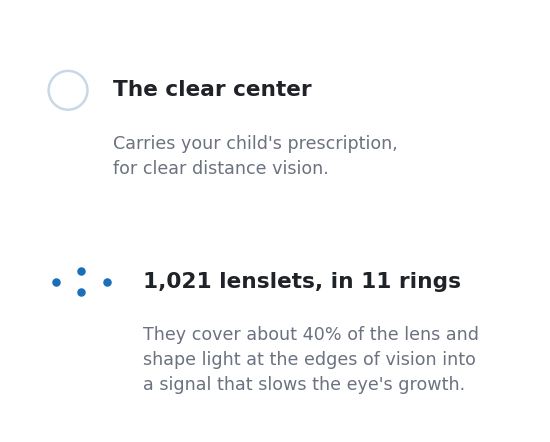
The center carries your child’s actual prescription. Clear, comfortable distance vision, the same as any pair of glasses.
Around it sit 1,021 microscopic lenslets, arranged in 11 concentric rings across about 40% of the lens surface. (2) They shape the light reaching the edges of the retina into a signal that slows the eye’s elongation. In everyday wear, nobody notices them.
Essilor calls the design H.A.L.T., for Highly Aspherical Lenslet Target. The name doesn’t mean the lenses “halt” or “stop” myopia. They slow it.
How the lens does two jobs at once
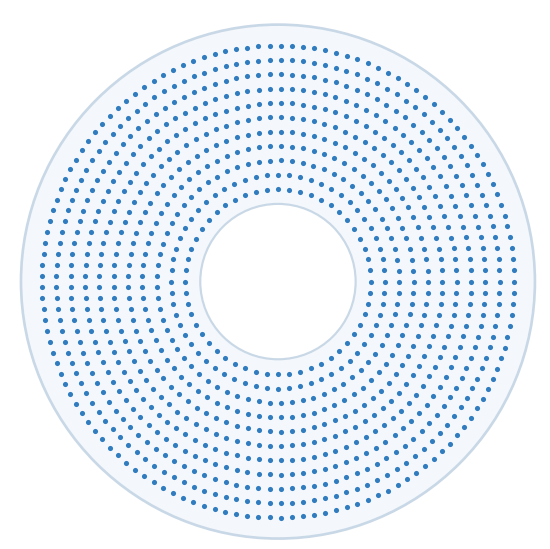
Shown enlarged. In everyday wear the lenslets aren’t noticeable.
What the Research Found
A study was done with children aged 6 to 12 over two years, randomized across multiple U.S. sites.
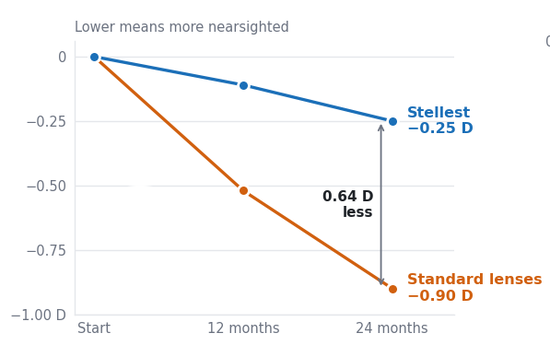
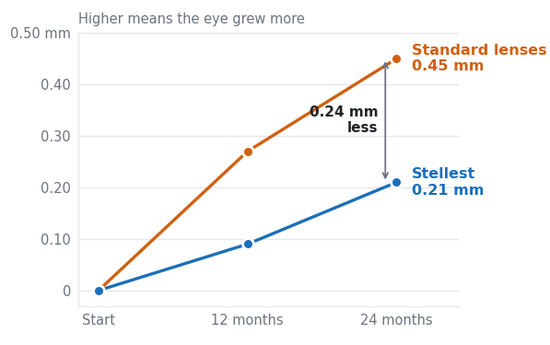
Children in standard single vision lenses progressed by an average of 0.90 diopters. Children in Stellest progressed by 0.25 — a difference of 0.64 diopters, or about 71%. (3) Measured by eye growth itself, the comparison was 0.45 mm against 0.21 mm, a reduction of roughly 53%.
In September 2025, the FDA authorized these lenses in the United States: the first spectacle lens cleared to slow myopia progression in children. (4)
Change in prescription
Growth in eye length
The Part That Depends on You
All of that assumes near-full-time wear. The lens works by delivering a consistent signal, and the signal has to actually be in front of the eye. Children who wore them at least 12 hours a day did meaningfully better than part-time wearers. (3)
So these become your child’s primary glasses — not a pair that lives in a backpack.
What Parents Usually Ask
Will they look different? No. The lenslets aren’t noticeable at conversational distance, and they work with a wide range of frames.
Will they hold up? They’re made in polycarbonate, which is dramatically more impact-resistant than standard lens materials, as well as lighter and thinner. Anti-reflective coating and full UV protection are included.
Is there an adjustment period? Usually brief. Some children notice slight blur or halos in their peripheral vision at first, which typically settles within a couple of weeks.
Are there other options? Several, all with evidence behind them: specialty soft multifocal contact lenses, overnight corneal reshaping lenses, and low-dose atropine drops. Which one fits depends on your child’s age, prescription, and daily routine. Let’s talk through the options during an eye exam.
What Treatment Looks Like
Exam, dispensing, then every six months to confirm the fit and track the prescription.
If your child’s prescription has gone up more than once, that’s worth a conversation.
Schedule a myopia assessment. Call 415-673-2020 or use our instant online booking tool.
— Your Optometry Team at Acuity Vision Optometry Boutique
For personalized service and vibrant neighborhoods, support local independent businesses like Acuity Vision Optometry Boutique!
References
- Projection based on published modeling of myopia progression by age of onset.
- Essilor technical specifications, H.A.L.T. technology.
- Results from a prospective, randomized, double-masked, multicenter U.S. clinical trial in myopic children aged 6–12 years at initiation of treatment, compared to single vision lenses.
- U.S. Food and Drug Administration, De Novo market authorization, September 2025.